Monday, 7 October 2013

Still in flower 6th October

There are still quite a few of our wildflowers in flower. I walked from Inganess up the Wideford Burn yesterday (6th) and the walk was brightened by the following:
Water Forget-me-not, Pink Purslane, Red Campion, Marsh Woundwort, Marsh Ragwort, Daisy, Dandelion, Water-cress, Creeping Buttercup, Creeping Thistle, Bush Vetch, Bell Heather, Tormentil, Catsear, Devil's-bit Scabious, Foxglove, Perennial Sowthistle, Hogweed. Birds included bramblings, Chiffchaff, Blackcap, Grey Wagtail and Buzzard.

Here are a few of the images from yesterday:

Pink Purslane

Water-cress

Bush Vetch

Devil's-bit Scabious

Marsh Ragwort

Dandelion

Foxglove

Red Campion

Daisy

Bell Heather

Marsh Woundwort

                                                               Water Forget-me-not

Tuesday, 28 May 2013

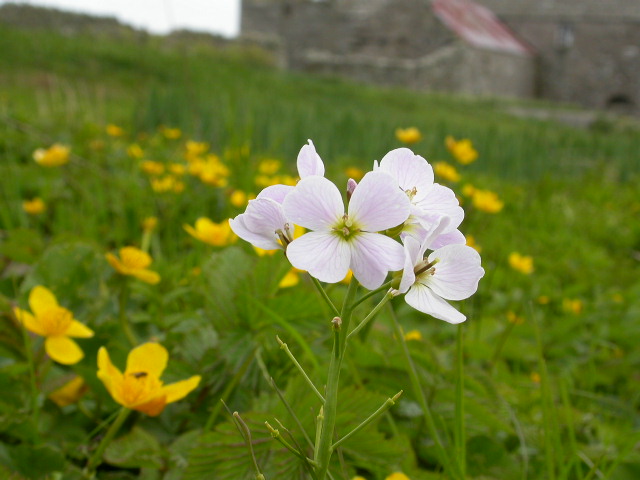
Cuckooflower at the Loch of Tankerness


After the dark days of winter the Cuckooflower, like the Marsh Marigold, is a welcome early bloom. It is common on damp verges where it provides a ribbon of colour or in marshes, ditches and damp pastures where on a spring day its four-petalled flowers of lilac are scattered like stars in the firmament. In among the lilac flowers are less numerous ones of rose-pink and white. Its lower leaves are large and kidney-shaped like those of Watercress (a very close relative) while its upper leaves are narrow.
 
This perennial has many local names most of them relating to milkmaids and smocks, cuckoos and virgins. It is a spring flower, coming out with the first calls of the Cuckoo. The Lady’s smock refers to the smock of the Virgin Mary, a relic supposedly found in the cave at Bethlehem. However it also has some undesirable associations; in Austria it was believed to be the favourite flower of adders, those who picked it would be bitten before the year was out and in Germany it was a thunder and storm flower, not to be picked for fear of the house being struck by lightning. It has been little-utilised in medicine but in Scotland it has been gathered as a salad and as a cure for epileptic fits.

Wednesday, 24 April 2013

Tuesday, 16 April 2013

The yellowing of the woodland floor

We are a little way behind 2012's flowerings. My diary for that year tells me that on 12th April there were Wood Anenomes in flower at Binscarth and Bluebells in Gyre. It also mentions baby Rooks in the 'willows' in Kirkwall. I visited Binscarth and Gyre on 15th April 2013 - no sign of Wood Anenomes, no sign of Bluebells and still no sound of baby Rooks in Kirkwall. The Snowdrops in both woodlands had turned but at last the woodland floor was changing colour - the brown earth was now spangled with the chrome yellow Lesser Celandine stars and in Binscarth the more subtle lemon-yellows of the understated Opposite-leaved Golden Saxifrage.


Thursday, 11 April 2013

An unprepossessing survivor to brighten up the days of spring - Sticky Mousear

It may be that you've never seen this little plant. It's not the most obvious of flowers but it tries its hardest to brighten up the dullest bits of concrete or tarmac at a time when we have a dearth of spring-time flowers. I don't know how it survives in Kirkwall; by July there are the little tell-tale marks on the pavements of the town where the Council spot sprayer has been. Maybe because it's an early flowerer, it can get away with the mid-summer treatment by which time it's flowers and greenery have vanished. I don't think you can find it everywhere in Kirkwall - it seems to be choosy - but try having a look at car parks especially where the kerb meets the tarmac. Arguably the best display I've seen recently has been at the Rendall Doocot car park although there is a bright and vivid line in Great Western Road (see below).


Wednesday, 20 March 2013

The locations for Anne's latest plate

For Anne's latest plate we've chosen two mainland localities and three island localities:
Bell heather - on Sanday with West Manse and the Sanday Community School in the background
Cross-leaved Heath - at Bossack, St Andrews in the East Mainland
Ling - at Mor Stein on Shapinsay
Tormentil - ruins above Rushacloust on Eday
Hard Fern - on the track to the Knowes of Trotty, Harray in the West Mainland

Saturday, 16 March 2013

The first Peat Hill species plate

The flowers shown here, from top left going clockwise are.... Bell Heather, Cross-leaved Heath, Ling, Tormentil and Hard Fern.

Monday, 25 February 2013

first bee of the year..............

Early spring in the Willows, Kirkwall
There are no Willows in the Willows. There are however plenty of Sycamores, a few Wych Elms, a Swedish Whitebeam and a handful of newly planted Hollies. It's a fine example of a Tame Woodland and planted among the trees are pockets of Snowdrops, Crocuses, Bluebells and Daffodils - it's the time of the Snowdrops and Crocuses now.  Along the burn you can find Lesser Celandines, the first ones are just bursting into flower this settled week. By May, Pink Purslane dominates the woodland floor to the extent that the leaves appear to choke everything else. Not so long ago there was a little patch of Ground Ivy which I have been unable to locate this year. Later in the year you can find Yellow Flag, Monkey-flowers and Water-cress along the burn edge. I was quite taken aback to find a honey bee exploring and gathering from the Snowdrop flowers - remind him we are still in February.


middle right - a honey bee hard at work - 25th Feb 2013


Wednesday, 30 January 2013

The first species plate in the 'Arable fields, waysides and disturbed ground series.  The flowers depicted are top left going clockwise; Bush Vetch, Meadow Vetchling, Fumitory sp, Tansy, Broad-leaved Dock, Tufted Vetch.


The locations for the species are as follows:
Bush Vetch (top left) - Greenwall, Holm
Meadow Vetchling (top middle) - the pier, Wyre
Fumitory sp (top right) - Bu Sands, Burray
Tansy (bottom right) - Happy Valley, Stenness
Broad-leaved Dock (bottom middle) - Burgar, Evie
Tufted Vetch (bottom left) - Eves Howe, Deerness

Tuesday, 8 January 2013

A bit late I know... but Anne and I would like to wish all our readers and watchers a very happy new year. Just to start off 2013 here is something entirely inappropriate and out of season. Neither Muckle Skerry or Red Poppies will feature in the Orkney Book of Wildflowers..... and, while we wait for the first Snowdrops and Lesser Celandines, those are four of the best reasons to include this fine summery picture.


Monday, 24 December 2012

Two new habitats

A couple of the best Christmas presents you could wish for - two more of Anne's plates - and as indicated both relating to habitats.
 
The upper plate represents the title plate for 'arable fields, waysides and disturbed ground'. As I mention in the text for the book this chapter has developed into something of ‘catch all’ section; within it are a variety of habitats, none of them natural, all of them manmade. Of course within this broad category there may be a high degree of overlap. This being the case, some of the wildflowers that are described and illustrated in this chapter are widespread and quite ubiquitous in their distribution - Daisy and Dandelion immediately spring to mind; both species may be found in almost any location.
 
Anne's plate is set on Flotta looking southwest over Kirk Bay with Switha on the left and South Walls on the right. The field is full of charlock while in the foreground from left to right are Hogweed, Purple ramping-fumitory, Ox-eye daisy, Ribwort plantain, Corn spurrey, Prickly sowthistle and Spear thistle. A Wren Troglodytes troglodytes, momentarily takes advantage of the Hogweed's height, in its constant search for insects.


The lower plate is the keystone plate for 'the peat hill – heath and blanket bog'. The draft introduction to this chapter is as follows:
'Of the ten habitats included in this volume, ‘the peat hill’ covers more of Orkney than any other and it can be found from near the coast to the summits of some of the county’s highest hills. Although peat is far less abundant on some of the north islands such as Sanday and Stronsay and non-existent on North Ronaldsay most of the other islands and parishes still have substantial areas of the peat hill; islands such as Eday, Hoy and Rousay are ‘peat’ islands and parishes such as Birsay, Firth and Orphir are similarly well-endowed. Indeed some of the best peat hills are nationally and internationally important designated sites most notably the Orphir and Stenness Hills, Keelylang Hill and Swartaback Burn, the West Mainland Moorlands and of course, Hoy.'
 
Anne's plate depicts the Rousay peat hill. We are at Catagreen on the northern ridge west of Kierfea and Whirliegar, overlooking the Cuppers of Vacquoy (the hill to the right).To the left is the Loch of Wasbister and Saviskaill while in the far distance and to the right is the sinuous coastline of Westray defined by Noup Head and Fitty Hill. The plate depicts the two main charactistics of the hill - the dry heath on the left and the wetter/boggy heath on the right. The plants of the drier heath include Ling and Bell heather - in the Scottish Borders known as 'He' heather and 'She' heather. The wetter/boggy heath is illustrated with Hare's-tail cottongrass, Butterwort, Sphagnum and Bog Asphodel.


Tuesday, 4 December 2012

Still surprising and it's December


2nd December - a sunny chilly day with a light breeze from the north. An ideal day to wander the cliffs of South Ronaldsay and take in the spectacle of Orkney's Grey Seal pupping season. And there was plenty of action. We witnessed suckling pups and wallowing pups, moulting pups and mewing pups. Some adults were relaxed, some were anything but and there were moments of high action involving possessive and territorial males intent on maintaining their gene pool. Doting mothers weren’t afraid to bare their teeth as they protected their offspring.

Our walk which took in both the east and west sides of South Ronaldsay also gave us the opportunity to see which of the county's plants were still in flower. We didn't have our noses to the ground most of the time and no doubt we missed a few, but there were a few surprises none more so than on the southwest facing cliffs south of Sandwick.

I make no apologies for including another picture of Sheep's-bit - there it was looking slightly less glamorous than a month ago, but very definitely still in flower.


While we were watching the Scarfies and Fulmars on the cliffs, the telescope also picked out the brown and dead flower-heads of Thrift, but in among them and looking quite vibrant were heads that were as pink as in the summer.


The 'pinks' are there if you peer hard enough!


but nothing like this - taken at the Shapinsay slip 'at the proper time of year'

We also saw Wild Angelica at Windwick, Common Catsear all over the coastal heath, Ragwort and Devil's-bit Scabious at Olad Brae, Meadow Buttercup in many places and Bell Heather at Halcro Head.

Saturday, 10 November 2012

Sheep's-bit - a November surprise


I couldn't believe my eyes in South Ronaldsay today......well it is 10th November - Sheep's-bit in flower. It's a rare plant in Orkney and by all accounts occurs solely on South Ronaldsay, Eday and North Ronaldsay. According to Elaine Bullard's 'Wildflowers in Orkney' it is restricted to 'sea banks on red sandstones only'. Its rarity within the county means that it won't feature in 'The Book'!!!!!

Sometimes it is called Sheep's-bit Scabious but it does not belong to the scabious family, it is one of the bellflowers.

Tuesday, 6 November 2012

Ruithy Girs - Corn Spurrey


And here is Orkney's other 'spurrey' - 'Ruithy Girs'; arguably it has always been far better known than the two saltmarsh spurreys due to its historical importance as a famine crop. However it is nowhere as abundant as it formerly was; it may be found in arable crops or more likely in set-aside. In bygone days it was harvested and the Orkney landscape would have featured extensive areas of the crop. I came upon such a field on Wyre in 2010. And here's the field southwest of Cubbie Roo's castle.


The draft text for this vanishing plant reads something like this:
 
Corn Spurrey (Spergula arvensis)   Campion family       Ruithy Girs

Height to 15cm; flowers July to September. Widespread and scarce in Orkney (22/28); not easy to find.

Often where it does occur, it grows in great abundance and it is not uncommon to see whole arable fields covered. It is an annual that can flourish in open and recently disturbed ground such as ploughed fields especially where the soils are light. In agricultural circles, a profusion of Corn Spurrey indicated the need to apply fertiliser. Despite its generally fragile appearance it is a plant with a robust and important history. There is evidence of its use as human food during Roman times and there is also speculation that in Orkney it may have been a key food source during the neolithic period. We know for a fact that Corn Spurrey has been grown as a fodder crop in Britain for centuries and in times of poor crop yields and shortages, its seeds were mixed with the crop grain and ground for flour. When not feeding humans it was more usually given as feed to hens.

The leaves appear dusty and are thin, blunt and furrowed below. They are thread-like and arranged in conspicuous whorls. Brittle stems support tiny, white, five-petalled flower-heads which are often turned down almost bestowing a shyness to this delicate and now declining plant.