Wednesday, 30 May 2012

Yellow Flag

After such a long winter the last week or so in Orkney has been a blessing. It has been a treat to feel warmth penetrating winter bones. Yet despite the favourable conditions the north wind still blows and the grass has barely grown. In recent years silage has been cut in the last week in May - it won't happen this year - it'll probably be another two weeks. So it came as something of a surprise when I was out with a class last night at the Dam of Hoxa in South Ronaldsay and found Yellow Flag in flower. It was a fairly large bed and there was but one bloom - maybe it was a freak, but a welcome freak.

Early in the season beds of Yellow Flag provide cover for Corncrakes when they first arrive in Orkney. This particular bed on Egilsay, also has Mare's-tail growing amongst it.

Corncrakes appear to prefer beds of Yellow Flag that are near buildings so that there calls can be accentuated by the echo effect.

I had two choices for the location of Yellow Flag

Stronsay mill
or

the mill of Boloquoy on Sanday

Boloquoy won - we just like the name!

And here is the text for this splendid plant

Yellow Iris (Iris pseudacorus)   Iris family                       Yellow lily, Segs
Queen-of-the-marshes, Queen-of-the-meadows
Height to 120cm; flowers May to July. Widespread and abundant in Orkney (26/28); easy to find.

In Somerset it is the Queen-of-the-marshes or the Queen-of-the-meadows, both names befitting such an elegant and statutesque plant. In the early days of April the first clumps of sword-shaped leaves stand proud like fakirs’ beds in all of Orkney’s damp and low-lying country. By June time these leaves are a metre high and chrome-yellow tipped buds, the colour of Whooper Swan’s beaks, soon unfurl chrome-yellow petals. By late autumn, the salt-laden gales have blackened the swords and the statuesque beauty of this perennial has shrivelled.

Iris is Greek for rainbow and symbolised life and resurrection and as an apotropaic averted evil. It is the source of the fleur-de-lys badge of French royalty and by the 19th century had risen to become a plant of poetry. It is also a versatile plant and has been put to a wide variety of practical and medical uses. The rhizomes and seeds produce a strong black dye for ink while in the Highlands and the Western Isles, the leaves were used for thatching and basketry. Coopers found a use for the dried leaves as gap fillers between the staves of barrels. Medicinally it featured as an astringent, a powerful cathartic, a treatment for ulcers in the Outer Hebrides while in Orkney, and quoted in Spence’s Flora Orcadensis, it appears that the juice from the roots was sucked up through the nose as a cure for toothache. Equally dramatic was its use on Mull where the rhizomes were crushed with Daisies and a teaspoonful of juice poured into each nostril, prompting a copious flow of mucus and saliva. The seeds were roasted to provide ‘coffee’ and ground to provide ‘snuff’. Not so long ago, children in Orkney made ‘seggy boats’ from the leaves and there was a belief among those that made the boats, that chewing the leaf would render one dumb. Remains of Yellow Iris have been found in the ancient middens of Orkney’s Skara Brae.

Saturday, 19 May 2012

Lousewort


In the last couple of weeks, despite the fact it has been so bitterly cold, a few flowers are beginning to poke through. I've taken birdwatching classes to Waulkmill and Corrigall in the last week and seen Red Campion, Common Milkwort, Common Dog Violet and Tormentil in flower.

The 'hill' can appear quite dead and brown over the winter - it's a long time till the first heathers start to bloom. Often the first plant of the hill to flower is Lousewort and its pink flowers brighten up some of the damper patches of the moorland. We came upon it at the end of April and each subsequent visit to the hill in early May has witnessed more and more in flower.


Here is the draft text for Lousewort:

Lousewort (Pedicularis sylvatica)   Figwort family
Money-in-the-purse, -the-box, -the-basket, -the-rattle.
Height to 15cm; flowers April to July. Widespread and abundant in Orkney (21/28); easy to find.

 The belief that this pretty perennial infests cattle and sheep with lice and liver fluke has been prevalent for centuries – hence its unfortunate name. Indeed recognition of this supposed ability no doubt accounts for the first part of its Latin name which means louse. The case for spreading lice is not proven but transmission of liver-flukes is possible. The plant succeeds in the poorest of wet and heathy soils; any browsing animals that have been sentenced to find nutrition in such conditions are in all probability likely to struggle and be susceptible to the water-borne liver-fluke embryos. Much better press is forthcoming from the Outer Hebrides where it is considered to increase the milk yield of goats and in Shetland where children used to seek out its sweet ‘honey’ flowers.


In Orkney it is most frequently found among heather where it has a distinct preference for the wetter areas; indeed occasionally it can be found in the drier parts of bogs and marshes. Like its close relative Yellow Rattle it is a part-parasite of roots, but unlike its close relative it occurs only on acidic soils. The many stems spread from the base and carry prettily crimped leaves while the fairly large Snapdragon-like flowers are composed of two dark pink petals the upper lip longer than the lower. As with many flowers, white-flowered forms are encountered sporadically. The inflated seed capsules, which persist into winter, are the reason for its other names Money-in-the-purse, -the- box, -the-basket and –the-rattle.


inflated seed capsules

Tuesday, 1 May 2012

Wetland plate four

Here's the next wetland plate.  There are 6 species in this one. clockwise from top; Greater Birdsfoot Trefoil, Brooklime, Meadow Buttercup, Water Horsetail, Marsh Horsetail and Brackish Water Crowfoot.


Saturday, 21 April 2012

Woodland wildflowers once more

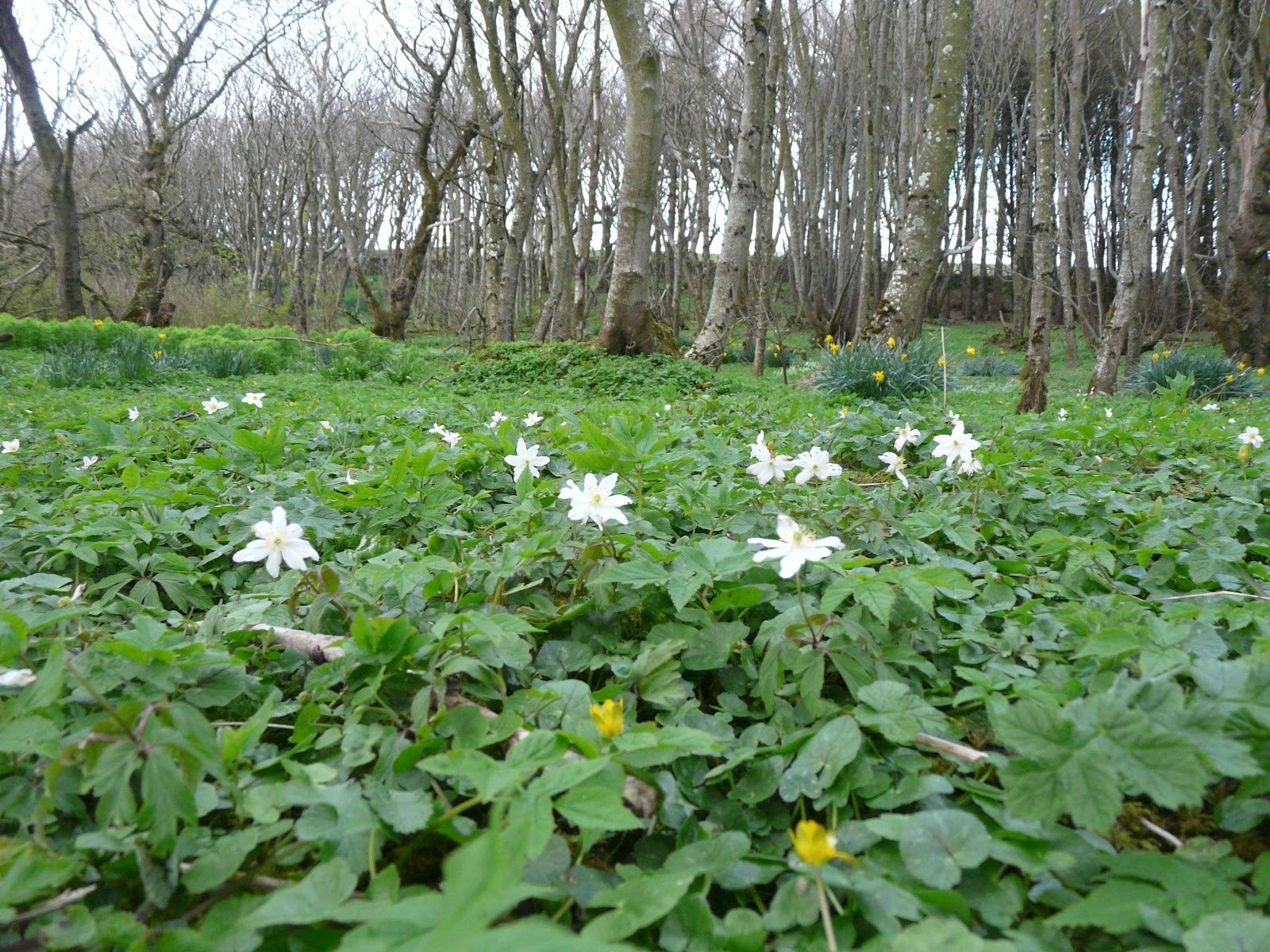
The wind was a raw northerly - it brought tears to your eyes. Just the sort of weather for us to explore the delights of Binscarth and Gyre - it was 10 degrees warmer in the woodland.. Quite recently I've posted about the Hard Shield Fern, Hart's-tongue Fern, Salmonberry and Opposite-leaved Golden Saxifrage. Our recent visit on 14th April yielded a tremendous display of Wood Anenomes and Few-flowered Garlic in Binscarth and Butterbur and Dog's Mercury in Gyre.

Los Afficionados


Wood Anenomes

Few-flowered Garlic
A subtle green line as flower-head decoration


The Binscarth verges were heady with the incense of Garlic

Dog's Mercury at its only site in Orkney

Butterbur 'forest'
Butterbur is also known as Bog Rhubarb


Tuesday, 17 April 2012

The locations for Anne's latest wetland plate....

You may find it fun to work out the setting for each of Anne's flowers. I hope I'm not spoiling it for anyone by giving the locations away.
Clockwise from the top left:
Soft Rush - North Mill, Eday
Sneezewort - Quoys, Graemsay
Marsh Ragwort - Loch of St Tredwell, Papa Westray
Yellow Flag - Boloquoy Mill, Sanday
Watercress - Burn of Lingro, St Ola
Marsh Bedstraw - Ring of Brodgar, from Sandwick

Monday, 9 April 2012

Wetland plate 3

Here's the next wetland plants plate.  Clockwise from top left the flowers are: Soft Rush, Sneezewort, Marsh Ragwort, Flag Iris, Watercress and Common Marsh Bedstraw......

Monday, 2 April 2012

Scurvy Grass

I noticed some clumps of Scurvy Grass in flower today at the Peedie Sea and on the roadside at Graemeshall in Holm. It's very much the early part of its season at the moment; it has a fairly drawn out flowering period but most flowers are over by mid July. Scurvygrass is complex and appears to be made up of a number of species yet to be resolved. In northern Scotland (and probably Orkney) there may be three species. The common form officinalis has large circular leaves about 3cm in diameter; a smaller form is scotica with leaves approx 1cm in diameter and the smallest with very small spade-shaped leaves is atlantica.

Peedie sea

Graemeshall 
 
officinalis?

scotica?
atlantica?

And here is the draft text for the book

Scurvy Grass (Cochlearia officinalis)   Cabbage family
Height to 25cm; flowers April to July. Widespread and abundant in Orkney (28/28); easy to find.

An early bloomer, this perennial herb can be found in Orkney on salt marsh, seacliffs, rocky shores and cliff top turf – in fact almost anywhere influenced by salt spray. It’s fun looking for this plant away from the sea and it is surprising where it turns up. I’ve seen it in full flower growing at the base of a wall near the Coop on Pickaquoy Road, Kirkwall but it can be found in the heart of the county, as far from the sea as is possible in Orkney. It can also be found growing on mountains in Scotland and northern England – on Ben Lawers in Perthshire it grows at 1155m. Recently it has become a roadside colonist along salted roads especially in the southwest of England. With its shiny and glossy, deep green, kidney to heart-shaped leaves it is a very conspicuous plant and becomes even more obvious in seabird colonies where nutrient enrichment results in much larger leaves and plants. Less conspicuous than the leaves are the honey-scented flowers which range from the standard white to a delicate shade of violet. It is obvious that in Orkney there is a great variation in size, petal colour and leaf shape giving rise to many unconfirmed records of the two subspecies known as scotica and atlantica

The plant has high vitamin C content and its antiscorbutic properties are widely known. In Faroe the leaves were employed in the treatment of nutritional disorders and in coastal England it was used as a folk remedy to counter scurvy long before the voyages of the 16th century. In the mid 17th century there was a fashion for a morning drink of scurvy grass and it was commonly grown in the physic corner of the garden. Writing of his Shetland experiences in the 18th century Brand states “They (the Shetlanders) have much scurvy grass: God so ordering it in his wise Providence…that seeing the scurvy is the common disease of the country, they should have the remedy at hand”.