1) In mid-July Anne removed the Banner. The Vat of Kirbuster on Stronsay was the setting for the 'Sea cliffs, Coastal grassland and Coastal heath' section of the book. It has been replaced by the habitat plate for 'Sand and Shingle Shores - the soft coast' (try saying that quickly). The setting for this habitat section is Sanday - more specifically the curiously named bay called Groanies adjacent to Start Point - you can see the lighthouse in the background.
Anne has painted typical wildflowers to be found there: Curled Dock, Perennial Sow-thistle, Sea Sandwort, Sea Rocket and Oysterplant.
2) Anne's latest plate, the fourth dealing with the 'Links and Dry grasslands' section features some very familiar and some less familiar wildflowers. The familiar ones are of course Bird's-foot Trefoil (Bay of Creekland, Hoy) and Self-heal (Birsay links). The less familar links plants are Bulbous Buttercup (Sand of Rothiesholm, Stronsay), Curved Sedge (Bu links, Burray), Sea Bindweed and Lesser Meadow-rue (both at the northern end of Newark Bay, South Ronaldsay).
Anne has done a super job with all of them and there is just one more 'Links'plate to do which will feature Red Clover, White Clover, Hardheads, Ragwort and Bugloss.
Showing posts with label Sea Sandwort. Show all posts
Showing posts with label Sea Sandwort. Show all posts
Monday, 8 August 2011


Sunday, 31 July 2011
Latest Wildflower walk - Saturday 30th July
Our fourth wildflower walk of the summer took us to Burray and South Ronaldsay to look at both the 'yellow dune' and the 'grey dune'.


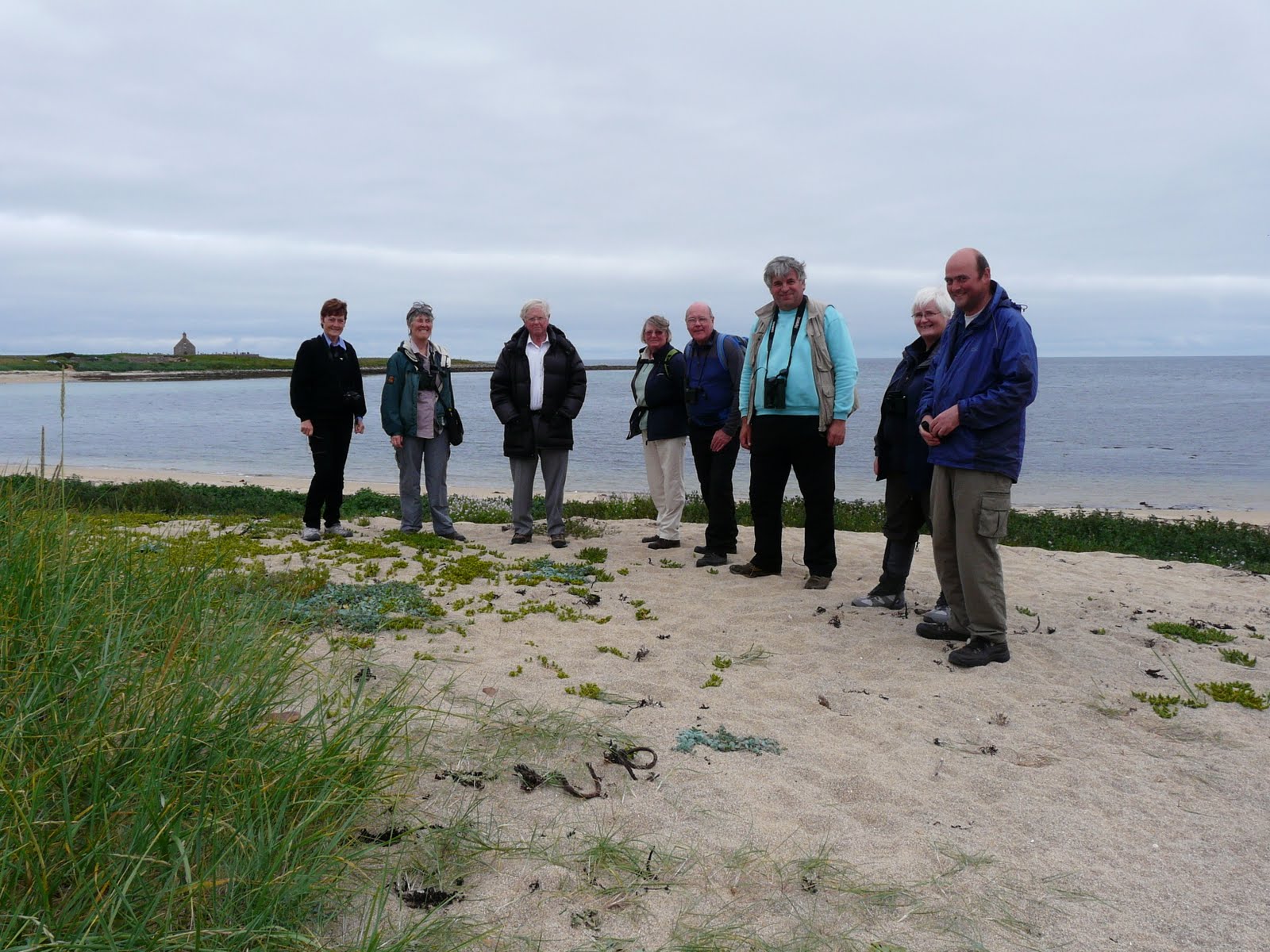
Los Afficionados admiring Oysterplant at the Pool o'Cletts, Eastside, South Ronaldsay
No4 barrier, Burray
Immature dunes (or Yellow dunes) are the sandy areas closest to the shore. The plants that grow there are integral to the formation of the dunes – their roots and leaves trap and hold the sand and are the first stage in the process of stabilisation. At the Fourth barrier, where the dunes are sixty years old, there is little maturity. The barrier is still very dynamic and ‘yellow’ and consequently is covered with early stage plants such as Lyme-grass, Marram Grass, Sea Sandwort and Orache. We also saw Perennial Sowthistle, Prickly Sowthistle, Common Catsear and Curled Dock, typical of this habitat and help in the formation of the mature or Grey dune.


Seeding Sea Sandwort
Immature dunes and beach
Orache, Sea Rocket, Lyme-grass, Marram Grass, Oysterplant, Sea Sandwort, Curled Dock.
Sea Rocket, in white and lilac, tended to lie lower on the beach than the Oysterplant. Both species still showed well but the Oysterplant, which in Britain only occurs in Scotland South Ronaldsay and Sanday pre-eminent.

Leaves the size of small cabbages on this Oysterplant
Mature dunes (or Grey dunes) are stable dunes which are characterised by species such as Ladies Bedstraw and Yarrow. Our walk along the upper path took us across carpets of bedstraw and passed clumps of Yarrow in many assorted pastel colours – white, pinks, magentas and lilacs.

Bird’s-foot Trefoil was still in flower but at this time in the year, the leaves begin to dominate. Angelica was beginning to unfurl while the Hogweed was starting to seed. Spear Thistles and Creeping Thistles grew abundantly in the overgrazed dunes inside the fence. At the southern end of the dunes were massed clumps of Lesser Meadow-rue none of which was in flower although we saw its seed-pods. However our exertions across the sands were not in vain – on a small sandy headland, Orkney’s only patch of Sea Bindweed was in full flower and we were a very appreciative audience. This little patch is out on a limb – the next nearest inScotland


Yarrow's stunning colours
Bird’s-foot Trefoil was still in flower but at this time in the year, the leaves begin to dominate. Angelica was beginning to unfurl while the Hogweed was starting to seed. Spear Thistles and Creeping Thistles grew abundantly in the overgrazed dunes inside the fence. At the southern end of the dunes were massed clumps of Lesser Meadow-rue none of which was in flower although we saw its seed-pods. However our exertions across the sands were not in vain – on a small sandy headland, Orkney’s only patch of Sea Bindweed was in full flower and we were a very appreciative audience. This little patch is out on a limb – the next nearest in

Sea Bindweed
Sunday, 29 May 2011
Today's snap! - the perfect subject
Even though I see Oysterplant every year, I find it impossible not to take pictures.
 |
| Pool o'Cletts - South Ronaldsay |
Wednesday, 19 January 2011
Sand and shingle - the soft coast
The first of the habitats includes ten species that are commonly (more or less) found on many of Orkney's soft coasts - the least common is Oysterplant one of the county's flagship flowers that is really only locally common on Sanday and South Ronaldsay.
Plate 1
Oysterplant, Cleavers, Sea Rocket, Sea Campion, Curled Dock
Plate 2
Sea Sandwort, Orache sp, Silverweed, Perennial Sowthistle, Sea Mayweed
And this is how the text should look for one of the shore's prettiest flowers Sea Campion


Plate 1
Oysterplant, Cleavers, Sea Rocket, Sea Campion, Curled Dock
Plate 2
Sea Sandwort, Orache sp, Silverweed, Perennial Sowthistle, Sea Mayweed
And this is how the text should look for one of the shore's prettiest flowers Sea Campion
Sea Campion (Silene uniflora)
Dead Man’s Bells, Dead Man’s Hatties, Witches’ Thimbles
Campion family
Height to 20cm; flowers May to July. Very widespread and abundant in Orkney (25/28) and around Britain ’s coasts (750/2852) but absent from most of the coastline of northeast England
Restricted to the coast and occurring from sea level driftline to cliff top grassland, this white flowered perennial has waxy leaves and an inflated calyx. It is a sprawling plant and likely to be found cascading over shingle or tumbling down near-vertical cliff faces; the latter habit resulting in two of its vernacular names Dead Man’s Bells and Dead Man’s Hatties – so named because of the inherent danger in attempting to gather a posy. It was never picked and never brought into the house possibly to discourage children from endangering themselves on the cliffs. Because of its ability to tolerate high levels of nutrient enrichment, white cushions of Sea Campion may be abundant in seabird colonies.


Subscribe to:
Posts (Atom)