At the moment Tim and I are working on the plates for the 'links' habitats. The habitat plate illustrates a dune from the Bu Sands in Burray. The dune itself, is not perhaps the richest in term of plant diversity that Orkney has to offer, (although Tim might be correcting me on this in the next post!) but I think it's important to not just depict the most obvious choices for each habitat. There are so many great places to choose from, it's nice to try and get a good variety. When Tim and I visited this location last year it was a pretty wild and windswept day - I wanted to get that across in the sky, with the addition of a bit of blue that I confess wasn't present on that particular day.
I'm now working on the first of three species plates for this habitat. Here's how it looks so far - I've got a bit bogged down with painting 4 zillion strands of Marram and Lyme Grass but for light relief I give myself 5 minutes of Heart's Ease Pansy now and again. I'll post the finished article soon.
The Orkney Book of Wildflowers is scheduled for publication at Christmas 2014. Tim Dean is writing the text, Anne Bignall is painting the habitats and flowers and the Orcadian is responsible for the publishing. The book will be a sister volume to The Orkney Book of Birds and will follow the same unique and successful format. There will be 50 plates depicting ten Orkney habitats and nearly 220 of Orkney's wildflowers.
Wednesday, 23 February 2011
Friday, 18 February 2011
The Tame Wood continued
The two plates that have been set aside for the Tame Wood section will include the following species:
Plate 34: Pink Purslane, Wood Anenome, Few-flowered Garlic, Salmonberry, Ground Elder, Daffodil
Plate 35: Polypody, Lesser Celandine, Bluebell, Snowdrop, Opposite-leaved Golden Saxifrage, Ground Ivy
The locations for these plants include Binscarth in Firth, Trumland in Rousay, Gyre in Orphir, Balfour Woods in Shapinsay, Woodwick in Evie and the Willows in Kirkwall.
Plate 34: Pink Purslane, Wood Anenome, Few-flowered Garlic, Salmonberry, Ground Elder, Daffodil
Plate 35: Polypody, Lesser Celandine, Bluebell, Snowdrop, Opposite-leaved Golden Saxifrage, Ground Ivy
The locations for these plants include Binscarth in Firth, Trumland in Rousay, Gyre in Orphir, Balfour Woods in Shapinsay, Woodwick in Evie and the Willows in Kirkwall.
Pink Purslane in the Willows
Few-flowered Garlic in Binscarth
Salmonberry in Trumland, Rousay
Salmonberry in Binscarth, Firth
Polypody in Binscarth, Firth
Bluebells in Trumland, Rousay
I've already included images of Snowdrops but thought you may like to see the Snowdrops in Happy Valley - the image was taken in 2010. If you visit tomorrow you would most likely be able to see an exact replica of this image
Monday, 14 February 2011
the Tame Wood
Following on from Anne's paintings of Binscarth in the late winter and early spring, it seems appropriate to put in a few images of some of the earliest flowers that we see in Orkney. I live just across from the Willows and in the last week the Snowdrops have gained strength as too have the leaves of Lesser Celandine. By early March, we should see their butter yellow flowers. In Binscarth, Wood Anemones will be at their delicate best as too will be the carpets of Opposite-leaved Golden Saxifrage.
Snowdrops in the Willows, Kirkwall
Snowdrops in Binscarth
Lesser Celandine
Wood Anenome in Binscarth
Opposite-leaved Golden Saxifrage in Binscarth
Opposite-leaved Golden Saxifrage in full bloom, Binscarth
Saturday, 12 February 2011
the colourful banner
Anne has added one of her plates for the background of the banner. It is in fact the habitat plate for Sea cliffs, coastal grasslands and coastal heaths - the vertical saltmarsh and depicts the cliff top above the Vat of Kirbuster on Stronsay with flowering Spring Squill and Thrift also known as Sea-pink and in Orkney as Arby
Wednesday, 9 February 2011
the Tame Wood
Orkney isn't exactly known for its woodlands but dotted around the county are small fragments of ancient scrub woodland and also what Tim has titled the 'tame wood' (as oppposed to the 'wild wood'). These vary considerably and each have their own character. My particular favourites include Happy Valley in Orphir and a real hidden gem is Olav's wood in South Ronaldsay. These places might not be for woodland purists - they have a really eclectic collection of species with everything from native willows to Monkey Puzzle. However, I find them magical places, they have a real sense of eccentricity and Olav's wood in particular is a magnet for migrant birds, eagerly looking for shelter.
The Tame Wood plates in our book were particularly enjoyable to paint. The habitat plate is taken from Binscarth Wood in Finstown - shown during late wiinter and very early spring with the large Sycamores and Wych Elms covered in moss. In the foreground are Lesser Celandines while across the burn are Snowdrops and Wood Anenomes.
There are two species plates for the 'Tame Wood' portraying 12 species in total.
The Tame Wood plates in our book were particularly enjoyable to paint. The habitat plate is taken from Binscarth Wood in Finstown - shown during late wiinter and very early spring with the large Sycamores and Wych Elms covered in moss. In the foreground are Lesser Celandines while across the burn are Snowdrops and Wood Anenomes.
There are two species plates for the 'Tame Wood' portraying 12 species in total.
Anne's plate features Binscarth's Wood Anenome in the top left, False Salmonberry in Trumland top right, Pink Purslane and Daffodil in Balfour Woods bottom left, Few-flowered Garlic in Binscarth bottom right and in the middle Ground Elder also in Binscarth.
Anne's other 'tame wood' plate depicts Lesser Celandine, Bluebell, Snowdrop, Opposite-leaved Golden Saxifrage, Ground Ivy and Polypody
Sunday, 6 February 2011
The chosen habitats of Orkney - from shore to hill top
I mentioned earlier that the The Orkney Book of Wildflowers begins its journey by the sea and finishes it on the high hills of Hoy. The habitats chosen are fairly broad in their range and we've deliberately tried to cut out the scientific jargon that can be a little off putting if you just want to identify your flower finds.
However, unfortunately not all wildflowers stick rigidly to their habitat type - many of the wildflowers may be found in more than one of the habitats. A good example of that is Thrift which essentially you can find anywhere where there is a liberal dousing of salt spray. We could have included it in the Saltmarsh section or the Sea Cliff section - we plumped for the latter.
Here is our list of habitats and their order in the book - there may be changes before Christmas 2013!
- Sand and shingle shores – the soft coast
- Salt marshes – the horizontal cliff
- Links and dry grasslands
- Lochs, burns, freshwater marshes and wet grasslands
- Sea cliffs, coastal grasslands and coastal heaths - the vertical saltmarsh
- Arable fields, waysides and disturbed ground
- Tame woods
- Wild woods and dales
- The Hill – the heather hill and the boggy hill
- Tundra – the high stony tops
Anne has completed the habitat plates for 1,2,3,4,5,7 and 8 and they will eventually find their way on to these pages.
Saturday, 5 February 2011
Oysterplant
Oysterplant (Mertensia maritima)
Sea Lungwort, Northern Shorewort
Borage family
Height to 50cm; flowers June to August. Local and scarce in Orkney (14/28); local and rare around Britain ’s coasts (71/2852)
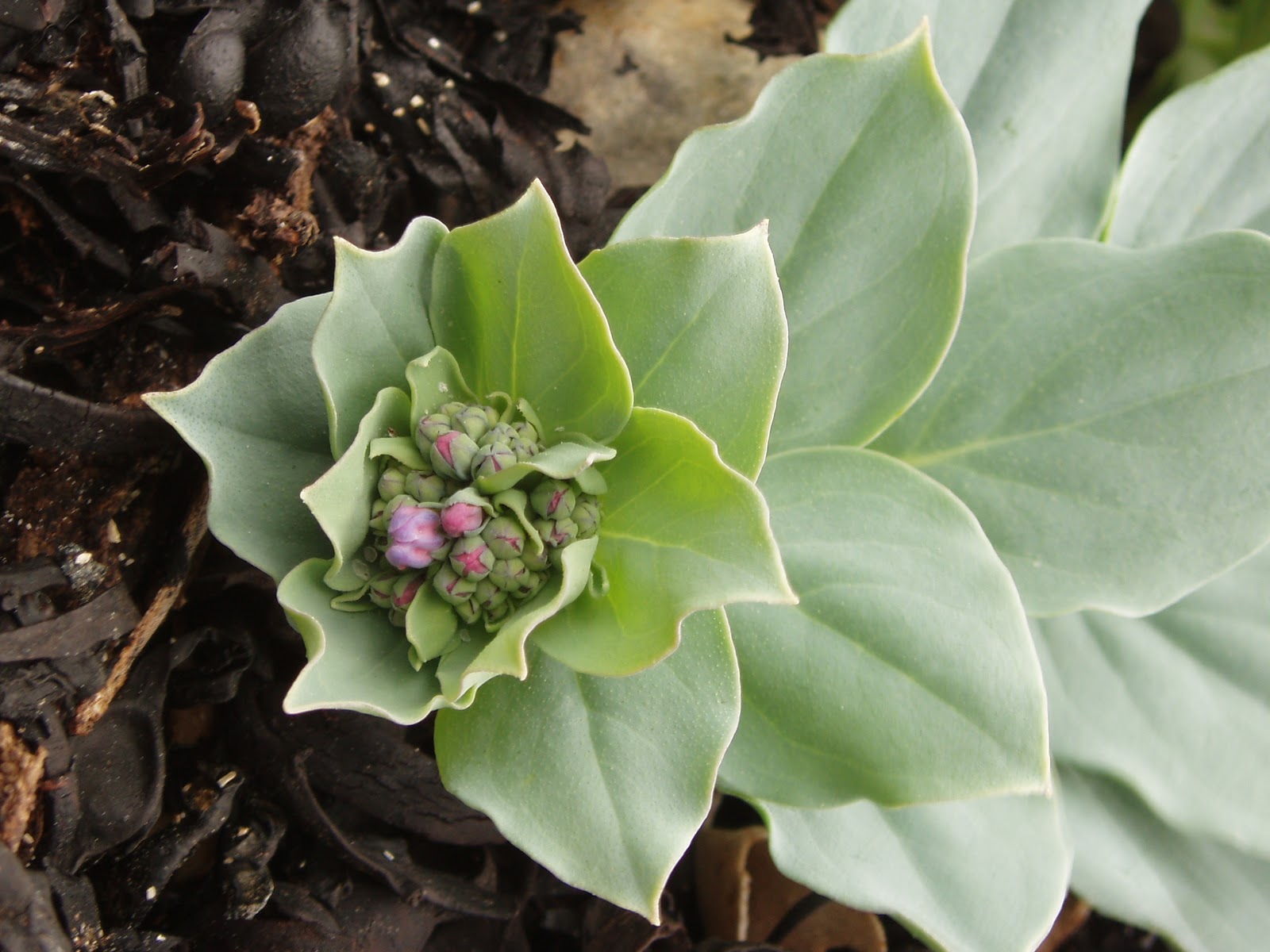
This exquisite perennial is a northern plant, Norway and Iceland being its citadels in Europe . In Britain it is rare and found almost exclusively in Scotland on the west and north coasts and in the Northern Isles; in England it is virtually extinct. Orkney is undoubtedly the plant’s stronghold and it would be no exaggeration to say that there are more plants here than anywhere else in the United Kingdom . Arguably it is as special to Orkney as the Scottish Primrose. However, within the county it has a restricted distribution and in recent years has disappeared from former sites most notably the Bay of Skaill in Sandwick and Birsay Bay but may still persist in low numbers on Westray and Stronsay. Nowadays it is most common on the soft coasts of Sanday, South Ronaldsay and at Newark Bay in Deerness. Plants may occur on beaches, both sandy and stony, where it thrives on soft surfaces disturbed by waves. It also thrives at No4 barrier where it grows along the A961 some 300 metres from the sea and a tyre’s width from the tarmac – here wave action is simulated by the blade of an Orkney Islands Council snow plough as it clears the build up of barrier sand after easterly gales. It has even been found growing on those unsightly spoil heaps of earth and rubble that appear all too frequently on Orkney’s shores in the name of coastal defence or coastal dump. Its rambling and leafy sprays radiate from the root like the spokes of a wheel. The leaves are oval, fleshy and grey-blue and its five-petalled flowers are initially pink before turning a radiant blue. The seeds can survive prolonged immersion in saltwater and its dispersion in sea currents enables the plant to colonise new but sometimes temporary sites; seeds have been known to travel at least 450km. Named because its leaves taste of oysters, its rarity should be a warning against collection.
==================================================================================
The location for the Oysterplant painting is at the Pool of Cletts on the east side of South Ronaldsay. In the background is Kirkhouse Point with St Peter's kirk, the old kirk house and the base of the kirk house windmill.
Anne's plate also depicts Sea Campion at Mar Wick Bay (top right), Curled Dock at Rapness on Westray (bottom left), Sea Rocket at Sandside Bay, Deerness (bottom right) and in the middle Cleavers at the Sand of Cornquoy in Holm
=================================================================
Tim has a real affinity with Oysterplant. For 14 years he worked on Walney Island in Cumbria as the warden of the South Walney Nature Reserve. Walney was one of the few places in England where Oysterplant had been recorded, and every year Tim looked for it, and failed to find it. The looking for it was akin to the search for the Holy Grail. Tim arrived on Walney in 1979; Oysterplant had last been recorded in 1974 and has not been relocated since. In Orkney he (and we) have the luxury of seeing hundreds of plants on beaches in South Ronaldsay and Sanday. The pictures below show the extent of Oysterplant at Liddle in South Ronaldsay where Common Gulls nest alongside.
Subscribe to:
Posts (Atom)