Tuesday, 19 July 2011

Monkeyflowers

If you are travelling along the Kirkwall/Stromness road at this time of the year, it's well worth stopping at Davey's Brig. Just south of the picnic tables at Davey's Brig, lying in the valley, is a swathe of yellow - Monkeyflowers in their golden glory. I haven't seen a more extensive spread. Smaller patches can be found in many waters including near the dam at Tormiston and even in the Willow Burn in Kirkwall. Arguably the upper reaches of the Desso Burn in Evie has some of the most spectacular clumps of Monkeyflowers.

Monkeyflowers


Monkeyflowers at Tormiston Mill

Desso Burn, Evie

Desso Burn, Evie
Here is the draft text for Monkeyflowers for the Orkney Book of Wildflowers

Monkeyflowers (Mimulus agg.)                   
Figwort family
Height to 40cm; flowers July to September. Local and scarce in Orkney (10/28); widespread and frequent in Britain (1275/2852)

Monkeyflowers originate in the Americas; native Americans and early travellers used it as a salt substitute to flavour wild game. It appears that the first plants to reach Europe came from the Aleutian Islands off the western coast of Alaska in the 18th century. The family includes Monkeyflower, Coppery Monkeyflower, Musk and Blood-drop-emlets and a very complex assortment of hybrids. By 1812, English gardens were resplendent with the family’s colourful blossoms and escaped plants were first noted during 1824 in South Wales. In the following 100 years members of the family became widely naturalised throughout Britain especially on marshy ground, along the edges of watercourses and on river shingle. Colonisation was made easier with the great increase in mileage of Britain’s canal system

In Orkney the most common species are Monkeyflower and Blood-drop-emlets. Both have yellow flowerheads but Monkeyflower has small red spots in its throat while Blood-drop-emlets has large red or purple blotches. Coppery Monkeyflower, with its coppery-orange flowers, occurs sparingly. It is believed to have been introduced in 1903 but Magnus Spence’s Flora Orcadensis (1914) makes no mention. They are thoroughly naturalised in Orkney and although looking quite at home along burns and ditches, they are absent from many parts of the county. Apparently it was common practice for a couple who were moving to a new parish to take a handful of roots to naturalise in their new surroundings.

Sunday, 10 July 2011

Wildflower walk at Yesnaby - July 9th

The heavens opened and rain of biblical proportions fell on Stenness and Sandwick. The road to Yesnaby was under 6" of water in three places - flash flooding - the soil was impervious to the rain and it ran in torrents across the baked earth. But by the time we assembled at Yesnaby, the deluge was but a recent memory. We were looking at the wildflowers of Coastal Grassland and Coastal Heath and were privileged to find that the Scottish Primrose (Primula scotica) was in the middle of one of its finest displays of recent years. The grassland was liberally sprinkled with Grass of Parnassus, Kidney Vetch, Wild Thyme (including the white variant), Sea Arrowgrass, Sea Plantain, Buck's-horn Plantain, Eyebright, Glaucous Sedge and Carnation Sedge. In the heathier areas at Inga Ness we found a fine population of Mountain Everlasting along with Slender St.John's-wort, Ling, Bell Heather, Cross-leaved Heath, Yellow Rattle, Crowberry, Flea Sedge, Viviparous Fescue and Creeping Willow.

Primula scotica, Yesnaby

Primula scotica, Yesnaby
Los Afficionados on Coastal Heath with Coastal Grassland over their shoulders

Grass of Parnassus

Grass of Parnassus

Mountain Everlasting

Mountain Everlasting

Wild Thyme with white variant

Saturday, 2 July 2011

Fox-and-cubs

We have chosen all the species that we are going to write about and illustrate for the Orkney Book of Wildflowers. It wasn't an easy task and there are some species that we would have liked to incorporate not just because they are common or pretty but also because they are part of the Orkney landscape. Species that fall into that category include Red Poppy, Blue Geranium and even Rhubarb. Last Tuesday while returning from Yesnaby, I came across another flower, Fox-and-cubs, that falls into this category.  It is certainly not as common as either of the three I've just mentioned but according to Elaine Bullard, does occur in two 'islandised squares', Rousay and Papa Westray. Well in fact it occurs in at least three squares - add Sandwick to that list. However, we've decided that it won't feature in the book and that's down to two reasons: i) it's not widespread enough and ii) it's a garden escape or outcast. I know that's all rather damning so I thought it would be reasonable to put in a few photos of this rather stunning plant and the slash of red that lights up the Voy quarry.


                                                                                                           The slash of red


Thursday, 30 June 2011

Difficult to get any better than this

On a beautiful summmer's day in Orkney, it is hard to surpass the floristic delights of the coast. This was at Yesnaby on Tuesday 28th June - the Primula was in its second flowering and my what a crop!


Monday, 20 June 2011

Missing links........

Tim has been busy out and about over the last few weeks and has done more than his fair share of posts.  Feeling somewhat guilty I thought I'd better pull my finger out and show a little of what has been happening with the last two 'links' plates for the book, just in case it seemed like production had stopped altogether.  Here's the fourth one - drawn and partially painted.  Usually I rough it all out in paint before going back over in more detail but this time I've opted to apply most of the detail from the word go - we'll see how this turns out.  I'm giving myself a deadline of 5th July to finish.  This includes four days away on the amazing uninhabited island of Swona doing other artwork and working full time in between. However, by writing a date here, I'm hoping to shame myself into sticking to it.


The last drawing for the links section is below.  When doing lots and lots of paintings, little details like the horses and bumble bee (which you can't see here but will be painted in later) are welcome additions.

Sunday, 19 June 2011

Orkney's Sundews

I spent a very damp Thursday on Hoy. The BBC had predicted a fine day with plenty of sun but I'm afraid to say the Beeb were way off the mark - not often Auntie gets this inexact science so wrong. The trip to Hoy had a purpose: monitoring the various sedges that are found in Alkaline Fen. Alkaline fen is a very special habitat that we find in Orkney, although it's not everywhere. Typically it is found in heath so its large-scale distribution in Orkney is limited to Westray, Rousay, the Mainland and Hoy. There will no doubt be pockets elsewhere and maybe folk can let me know. 'The Orkney Book of Wildflowers' deals in broader habitats - so some of the plants that we find in Alkaline Fen will be found in the book in 'The Hill' section. One of the really typical plants that indicates Alkaline Fen is Black Bog Rush.

Black Bog Rush

Black Bog Rush and Alkaline Fen

Two of my favourite species are the Common (or Round-leaved) Sundew and the Great Sundew. These insectivorous plants are fascinating creations that obtain most of their nutrients from tiny insects that become trapped in 'Sundew glue'. The two Sundews are quite different - the Great Sundew holds its oval leaves up while the Common Sundew holds its round leaves flat in a circle. In addition, while both are found 'in the Hill' they tend to occur in different parts of the hill. You've guessed it - the Great Sundew tends to occur in Alkaline Fen areas and the Common Sundew is more likely to be found in the peaty areas amongst Sphagna.

Great Sundew

Great Sundew

Great Sundew

Great Sundew

Common Sundew

Common Sundew

Sunday, 12 June 2011

Waulkmill's flowers - quite an afternoon - 11 June 2011

Waulkmill Bay
Los Afficionados at Waulkmill

Sea Milkwort

Sea Arrowgrass
Butterwort
Goldenrod

Wood Sage

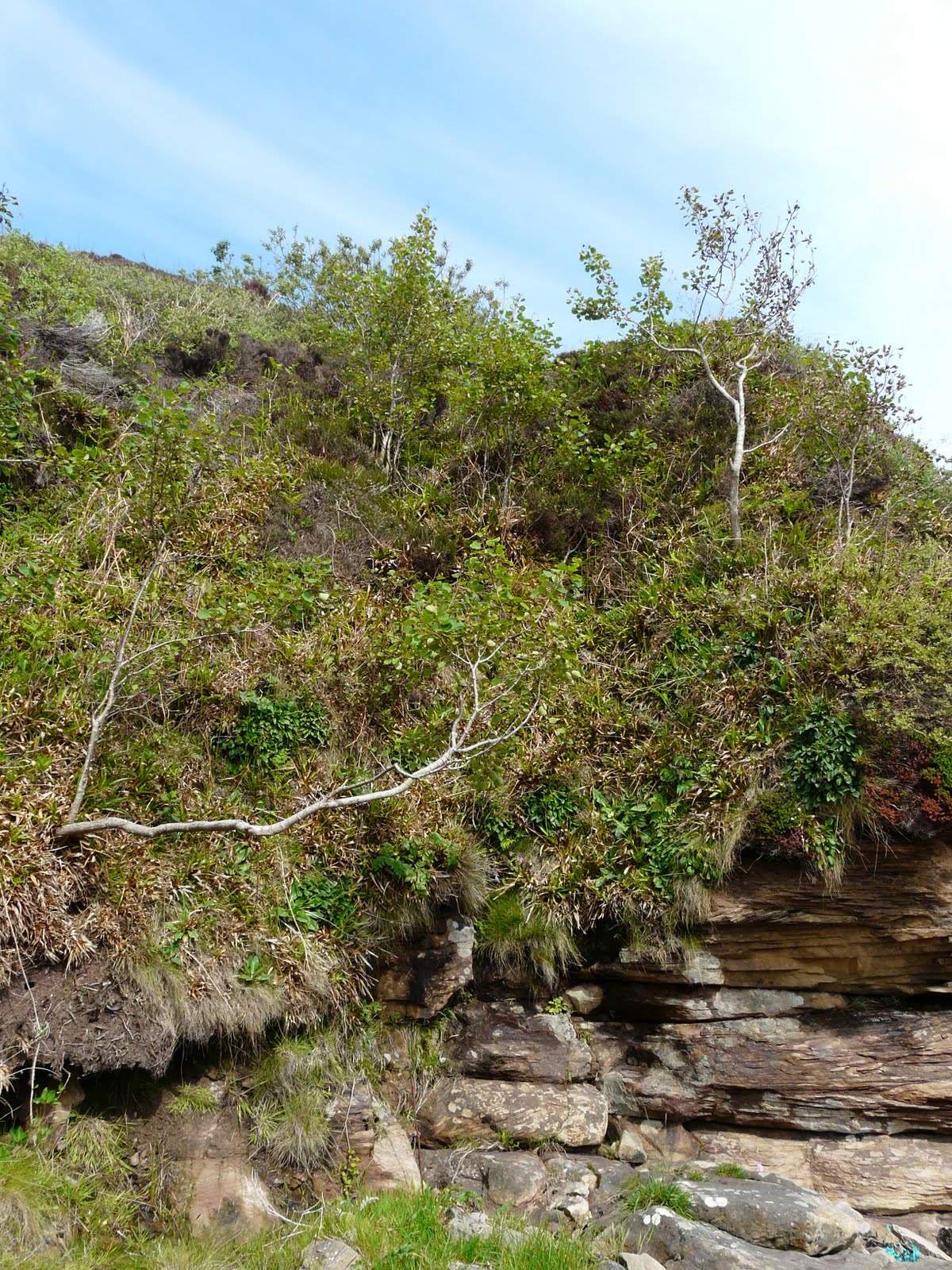
Aspens

Aspen jnr


Red Admiral on Thrift